Exhaustion Is Your Body’s Check Engine Light: Here’s How to Check Under the Hood
You know that red engine light that blinks on while you're driving, and you sort of just... don't look at it?
You're already running late. You're already behind on seventeen other things. And somewhere in the back of your brain you've absorbed the idea that if you don't make eye contact with a problem, it doesn't fully exist yet.
That's exactly what most women do with exhaustion. Not the "I stayed up too late watching one more episode" exhaustion. The kind that follows you into the shower in the morning and is still sitting next to you at midnight when the house finally goes quiet.
If you are functioning but completely fried, secretly fantasizing about moving somewhere no one can ask what's for dinner, welcome. You're my people.
I want you to know that what you're experiencing is not a sleep debt or a hydration problem. It's a warning signal, and it's been trying to get your attention for a while now.
Let’s talk about it.

Why Women Are Always Tired
Women are trained from an early age to anticipate needs, manage everyone's emotional weather, remember everything, smooth everything over, and make all of it look effortless. The cost is always the same: your energy, your patience, your health, your sense of self. It’s enough to make you question your sanity.
And then the mainstream wellness industry tells you to treat rest like a reward you have to earn after you finish everything for everyone else. Hilarious, right? Because everything never finishes.
So you keep pushing through, adjusting, coping, carrying, remaining capable and reliable and always the one who handles it, until quietly and without any dramatic announcement, living in a state of constant depletion becomes your baseline.
And you blame yourself for it.
The truth is, the mental load you carry isn't just an emotional burden—it has physical consequences. Here is the actual cost of carrying the invisible load:
The Body: chronic stress can increase blood pressure, weaken the immune system, and trigger depression, and it causes mental fatigue that makes it harder to think, reason, and focus.[1]
The Mind: that foggy brain you've been trying to push through? Brain fog from stress commonly shows up as difficulty concentrating, mental fatigue, and forgetfulness, with chronic or extreme stress far more likely to disrupt cognitive function than short-term stress.[2]
The Nervous System: the short fuse, the numbness, the "I can't think straight" feeling that doesn't go away even when you finally get a minute: that is your nervous system reporting the truth about what it's been carrying.[3]
All of these are what trigger your check engine light. And if you are in your 40s or 50s, there is a second, invisible layer of biological wiring that is actively magnifying this load: Perimenopause.
The section layer causing your exhaustion
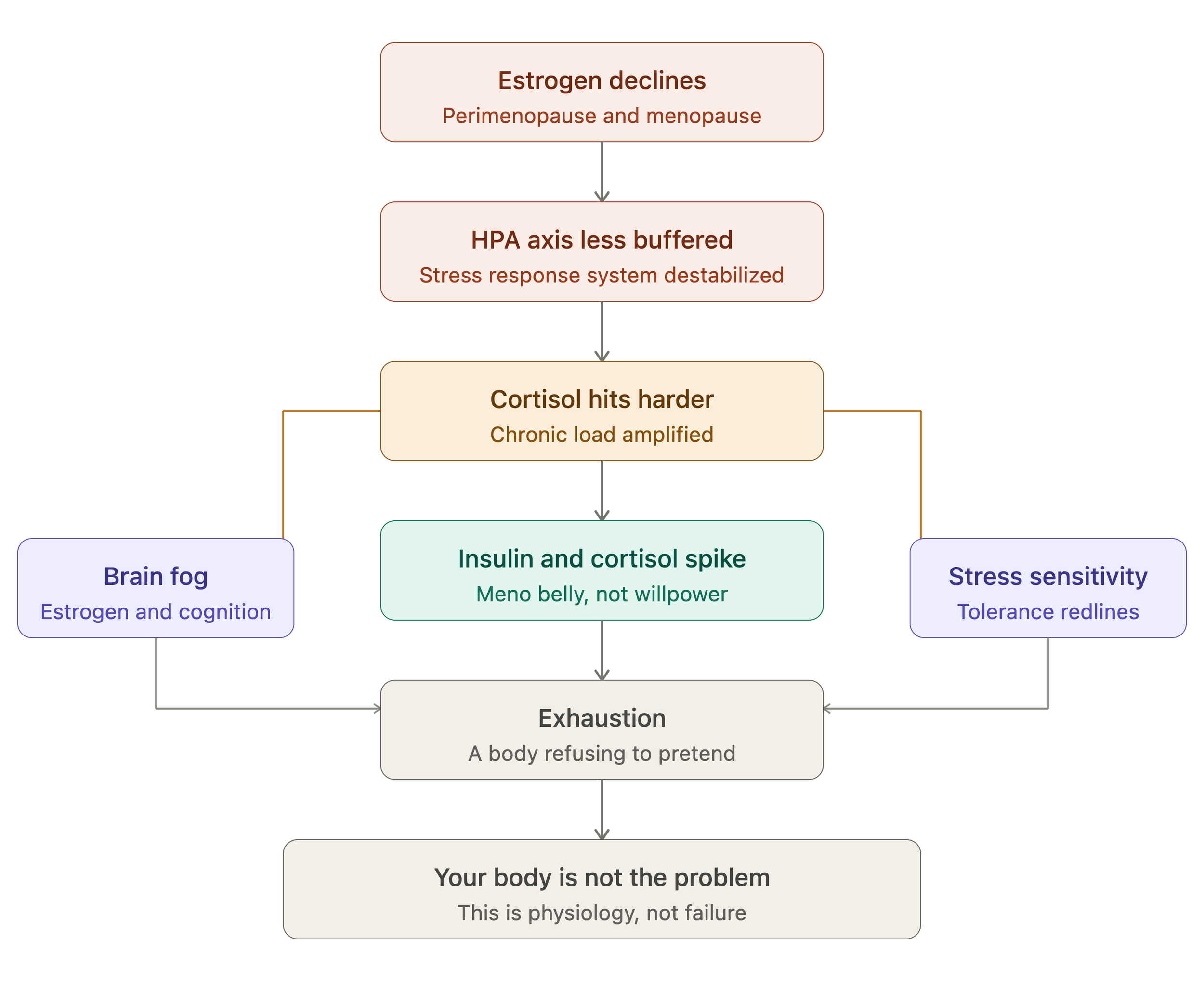
Perimenopause is characterized by a decline in estrogen (estradiol) and progesterone. Cortisol, the primary marker of the hypothalamic-pituitary-adrenal (HPA) axis is your body's main way of responding to stress activity, increases.[3]
What this means is, your body is simultaneously losing the hormones that support calm, deep sleep, and cognitive clarity, while ramping up the stress hormone. Declining progesterone, recognized for its calming and sleep-promoting effects, contributes directly to dysregulated sleep, and those abnormal cortisol patterns, particularly in the evenings, also interfere with sleep quality which leads to daytime exhaustion.[4]
As you can see in the diagram, perimenopause changes the baseline. When you stack your invisible mental load on top of that already redlining system, you aren't just tired—you are managing a fundamental shift in your hormonal foundation.
This is exactly why standard “wellness hacks” have failed you. (If you want to go deeper on why your system hits this wall, read Why Do I Feel Exhausted Even When Everything Seems Fine.
The Check Engine Light Doesn't Mean Drive Faster
When the warning light comes on in your car, the goal is to pull over and look under the hood.
Your exhaustion is useful information. It is telling you that something in your system has been running beyond its capacity for too long, and your body is done quietly absorbing the damage. The fog, the rage, the emotional numbness, the fantasies about disappearing: those are not signs that you are weak. They are your dashboard doing its job.
The fix is not a better morning routine, a prettier planner, or a mindfulness practice you squeeze in between everyone else's needs. It starts with immediate, physiological relief to tell your nervous system it is safe to downshift.
Here are three high-value, immediate actions you can take today to get relief, along with the science of why they actually work.
1. Complete the Stress Response Cycle (The 2-Minute Reset)
The Action: Spend two minutes doing something that physically changes your state. Shake out your hands and arms vigorously or hop in place, take five slow exhales that are longer than your inhales, or go stand in the sunlight as you do any movement for 2-minutes (dancing counts)
The Science: When you carry an invisible load, your body is trapped in a low-grade, constant fight-or-flight state, keeping cortisol high. Removing the stressor (like your to-do list) doesn't tell your body it's safe. Physical movement and long exhales stimulate the vagus nerve, activating your parasympathetic nervous system. This signals your brain that the immediate danger has passed, forcing cortisol levels to drop.
2. Radical Boundary Auditing (Put Down One Thing)
The Action: Look at your schedule for the next 48 hours. Find one thing you are doing automatically out of habit, guilt, or overfunctioning—and drop it. Hand it to someone else without an explanation or an apology, or delete it entirely. (If someone complains, they can take it over.)
The Science: Chronic stress over-activates the HPA axis, leading to severe cognitive fatigue and brain fog. By making a conscious decision to eliminate a demand, you create immediate space, or “cognitive margin”. This reduction in incoming stimuli stops the relentless depletion of the “feel good” hormone, dopamine and the neurotransmitter hormone, norepinephrine, giving your brain the literal breathing room it needs to process thoughts clearly again.
3. Protect Your Glucose and Progesterone (The Low-Energy Snack)
The Action: If you are running on empty, do not skip meals or reach for a sugary coffee or a “protein bar” (those are not food!). Eat a small snack combining a complex carbohydrate with a fat or protein (like an apple with almond butter or a handful of walnuts) before you hit your late-afternoon wall.
The Science: Fluctuating estrogen and declining progesterone make your body significantly more sensitive to insulin resistance and blood sugar crashes. When blood sugar drops, your body triggers a rescue spike of cortisol to raise it—which mimics a panic attack and causes acute exhaustion. Feeding your body steady, slow-burning fuel prevents these emergency cortisol spikes, protecting your remaining energy baseline.
I want you to recognize that the emotional management that somehow became your job, the conflict you prevent before it happens so everyone else stays comfortable, the guilt that lives in your body—none of that was yours to carry.
And none of it will stop until you see it clearly enough to put it down.
That is where the pressure starts to shift and the check engine light goes out.
If you want to go deeper on what's underneath the exhaustion, read Overwhelmed, Not Broken: Why Exhausted Women Hit a Wall.
Before You Go
If you don’t even know where to start filtering the noise, take 2 minutes to check your dashboard with my Mental Load Calculator. It will give you a real score reflecting how depleted you are, plus a simple tip to lighten the load.
Stay fierce,
Melissa







Sources
Healthline / Medical News Today. (2026). Brain Fog: 6 Potential Causes. Citing 2017 chronic stress research review.
SensIQ. (2026). Stress and Brain Fog: Causes, Symptoms, and Clinical Context.
Grub, J., Süss, H., Willi, J., & Ehlert, U. (2021). Steroid Hormone Secretion Over the Course of the Perimenopause: Findings From the Swiss Perimenopause Study. Frontiers in Global Women's Health. PubMed 34970652.
International Journal on Science and Technology (IJSAT). (2025). Endocrine and Metabolic Mechanisms Underlying Fatigue in Perimenopausal Women.
Shors, T.J. et al. (2024). The Role of the Hypothalamic-Pituitary-Adrenal Axis in Depression Across the Female Reproductive Lifecycle. PMC10750128.