
The Wellness Industry Doesn’t Want You Healed, It Wants You Subscribed
You've probably stood in the supplement aisle, staring at a $47 adaptogenic blend with a name like "Radiance Within," wondering if this is “the one”. The thing that finally makes you feel like yourself again.
Maybe you drank the designer herbal tea with imported manuka honey. Put the multi-type (because the more types, the better) collagen powder in all of your beverages. Used the $300 anti-aging cream containing female Himalayan bee venom on your face and the back of your hands. Put “hydration packets” in that designer water tumbler because it not only makes your water more watery it also “detoxes your liver”. Ate the low-fat, low-carb, high-fiber, high-protein sawdust bar instead of a balanced meal because your naughty waistline deserves punishment and deprivation.
And you still woke up every morning feeling like an exhausted stranger in someone else’s skin.
I understand the struggle, I’ve been there.
You see, the wellness industry doesn’t profit from women who love their midlife body; the body that survive hard things, healed the sick, and created new human beings and feed them. The body that carries the ancient wisdom and knowing that only women’s bodies can.
Let’s talk about it.
The Five-Trillion Dollar Machine Encouraging Your Self-Doubt
The global wellness industry is worth somewhere north of five trillion dollars. [1] Let that number sit for a second. Five trill-ee-un. And it’s built largely on the premise that you are broken, and that the right product, protocol, or positive thinking practice can fix you if you just want it badly enough.
Self-confidence and self-care got sucked into that machine right alongside celery juice and red light therapy. Self-love was repackaged as a mindset. A vibe. A decision you make in the morning while you’re fighting your cortisol spike. Buy the journal! Think the happy thoughts! Stack the habits (because you need more things to pile on your to-do list). Perform the “self-care” rituals and mean it this time!
And when none of it works, the industry has a very convenient explanation. You're not doing it right. You haven't found the right combination or practice yet. You didn’t pair it with the miracle serum. You didn’t try hard enough.
Here's what that model requires to keep running: your belief that you are the problem.
A woman who has genuinely accepted herself exactly as she is right now, brain fog, belly fat, bone-deep fatigue, identity rupture and all, she is a terrible customer. She doesn't buy the magic fix because she has stopped looking for one. [2]
How Self-Love Became a Product
The language got smarter over time. It stopped saying "fix yourself" and started saying "optimize yourself." It borrowed the vocabulary of empowerment — glow up, level up, invest in yourself — and aimed it directly at women who are already exhausted from investing in everyone else. [3]
Self-love as a commodity always points outward. Toward a product, a program, a morning routine designed by someone who has never met you. It asks you to acquire something in order to feel something. Which means the feeling you are searching for is always one purchase out of reach. The goalpost moves. The wallet empties. The self-doubt stays.
“Put the word “meno” in front of a product and you can, apparently, double the price without changing the formula.”
Midlife women are a particularly easy target for this kind of wellness marketing. The menopause supplement market alone is projected to surpass $24 billion globally by 2030. [4] Put the word "meno" in front of a product and you can, apparently, double the price without changing the formula. Slap "hormone-balancing" on a cream that cannot physiologically balance hormones — because if it could, it would be classified as a drug — and watch it sell out. [4]
None of this is wellness. It is the manufacturing of insecurity, dressed in the language of self-care, aimed at women whose bodies and lives are in genuine transition and who have been told that transition is a problem to be managed. [5]
You are not a problem to be managed.
Why Midlife Is When the Machine Gets Loudest
A culture that values women primarily for their youth and reproductive utility has very little infrastructure for a woman who has moved past both. [6] By midlife, most of us have spent decades being evaluated by partners, employers, families, and entire industries based on metrics that have an expiration date. Youth. Fertility. A particular body size. When those metrics shift, the message is relentless: you are now working against the clock, and if you don't start taking care of yourself, who's going to want you?
Beauty brands, supplement companies, and wellness platforms profit from that anxiety. The more uncomfortable a woman feels with normal physiological change, the more solutions can be sold to her. [6] An older woman who has stopped participating in that transaction, who looks in the mirror and sees someone worthy as she currently is, is highly inconvenient to that profit model.
So the model keeps moving the goalpost. Keeps reminding her she could look younger, feel better, do more if she would just buy the thing. Don't get left behind.
What’s Happening In Your Body
Here is a quick dose of science, because you deserve an actual explanation instead of a serum.
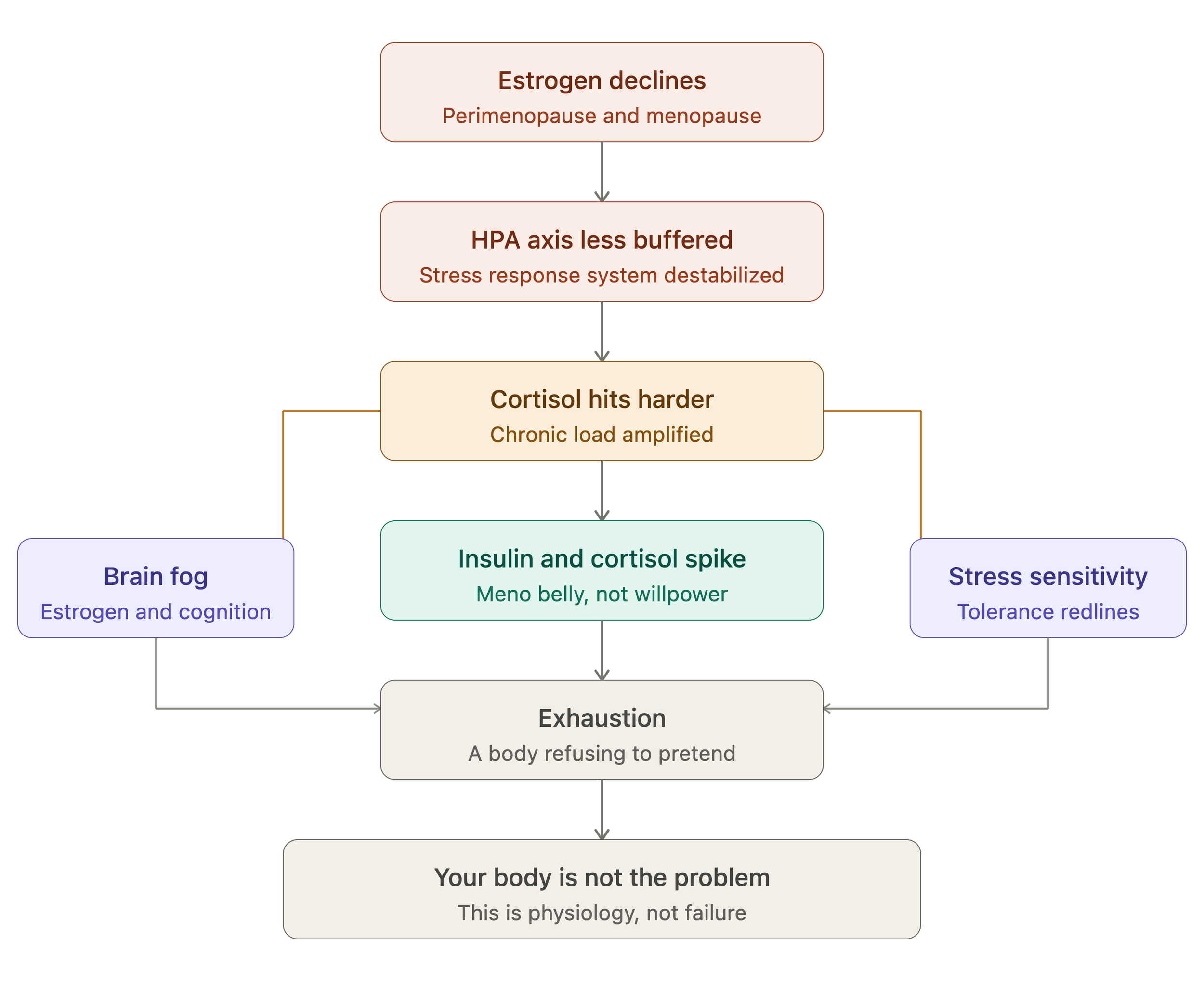
During perimenopause and menopause, estrogen, which plays a direct role in cognitive function, memory, and mood, declines significantly. [7] That brain fog you keep apologizing for? The word that vanishes mid-sentence? The meeting you walked out of feeling like you'd been running on dial-up? That is a documented neurological consequence of hormonal transition. [8] A character flaw it is not. Early decline it is not. Something a better morning routine fixes it is absolutely not.
Meanwhile, declining estrogen also increases your sensitivity to stress. The HPA axis, the system that manages your cortisol response, becomes less buffered as hormone levels drop. [9] The chronic load you've been carrying for years hits harder now because the hormonal cushion is getting thinner.
Your tolerance for nonsense redlines and stays there. Scientifically speaking.
The meno belly is cortisol and insulin doing their jobs under duress, not a referendum on your willpower. The identity confusion is real neurological and hormonal rewiring, not weakness. The exhaustion is a body that has been running at capacity for a long time, finally refusing to pretend otherwise.
When your life feels like it has gone sideways and you can't explain why, that is not a personal failing. That is a woman in the middle of a significant biological and psychological transition, living in a culture that gave her no instruction manual and sold her expensive supplements instead.
Your body is not your enemy. Right now, it is the most honest thing in your life.
What Self-Acceptance Looks Like Without the Products
Real self-acceptance is not a morning ritual. It's an orientation. A decision you make, repeatedly and imperfectly, to stop auditing yourself against standards designed to keep you purchasing.
Research on self-compassion, treating yourself with the basic decency you would extend to someone you actually like, points to more stable and durable self-worth than self-esteem built on performance metrics. [10] Self-compassion does not ask you to feel good about everything. It asks you to stop punishing yourself for being human in a body going through something real.
Your 45-plus-year-old body is not a lesser version of your 25-year-old body. It is a different body, carrying a different life, with a completely different relationship to itself. [11] The wisdom that came from the failures and the years and the things you survived? You built that. Nobody sold it to you.
Accepting where you are right now doesn't mean staying there. If you want to change something, pursue something, shed something, rebuild something from the ground up, that is entirely available to you. Growth is always on the table.
What self-love looks like with teeth is this: knowing the difference between change you choose and change you've been pressured into because someone told you that you were the problem. Choosing the former. Rejecting the latter. Spending the $47 on literally anything else.
The industry built a five-trillion-dollar machine on your self-doubt. You don't have to keep feeding it.
Before You Go
I'm building a space for women who are done performing, both at home and in the boardroom. If you enjoyed this article, I invite you to stick around and join my community of fierce women.
I encourage you to subscribe to The Fierce Weekly Edit. Every Sunday, I write rebel wellness topics that call out the systems that keep us small and exhausted and offer small acts of non-compliance to break free (so you can find your fierce!). It will include the behind-the scenes series Tales From the River and include whatever settled my nervous system that week; a recipe, a book, a walk by the river. t's where you get to know the woman behind the brand, in the vintage RV parked next to a river.
And if you feel like leaving a comment down below, I welcome it. You might encourage or inspire another reader who is struggling and needs to know she is not alone.
Stay fierce,
Melissa




Sources
Global Wellness Institute. Global Wellness Economy Monitor. 2023.
Fruchter J. Shielding Ourselves from Toxic Youth Culture in Midlife. 2026.
Mair C. The Manufactured Insecurity of Women. 2026.
MUTU System. Menowashing: How the Wellness Industry Hijacked Midlife for Profit.2025.
Fit Bottomed Girls. The Wellness Industry Trap. 2025.
Fruchter J. Shielding Ourselves from Toxic Youth Culture in Midlife. 2026.
Maki PM, Jaff NG. Brain fog in menopause: a health-care professional's guide for decision-making and counseling on cognition. Climacteric. 2022;25:570–578.
PMC/NIH. Sleep and Brain Function at Menopause. 2025.
Kim YJ et al. Menopausal stage transitions and associations with perceived stress in middle-aged women. Maturitas. 2025.
Neff KD. Self-Compassion: Theory, Method, Research, and Intervention. Annual Review of Psychology. 2023;74:193–218.
Albertson ER, Neff KD, Dill-Shackleford KE. Self-compassion and body dissatisfaction in women: A randomized controlled trial of a brief meditation intervention. Mindfulness. 2015;6(3):444–454.
Labs don’t explain why a dirty dish in the sink makes me rage or why I can’t remember why I walked into a room. Here’s what lab tests can’t see.